
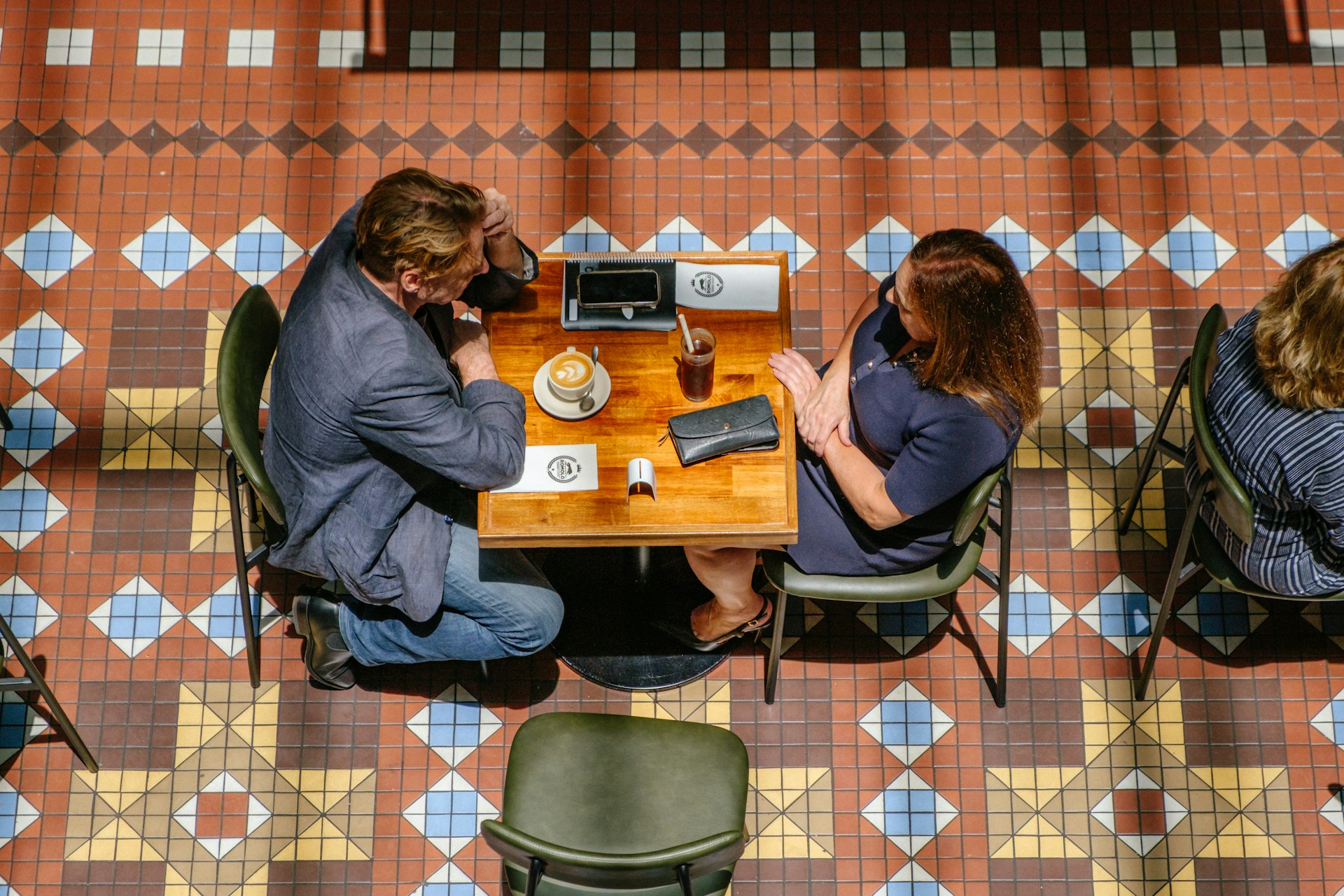
Why can the coffee house not be rebuilt inside the corporation? Because it lacks precisely what makes it what it is: the absence of intent. On Muße as an enabler of the new — and on what organizations can learn from it. Part 2 of 2.
In the first part we looked at the coffee house as a place of learning: as a semi-public space that offers the very friction between retreat and world out of which new knowledge arises in the first place — and which the modern open-plan office so conspicuously lacks. The decisive question remained open: what exactly accounts for this difference?
The answer leads to a word that hardly occurs in the vocabulary of modern organizations, and certainly not in the quarterly report: Muße — contemplative leisure.
Muße is not downtime
What artists and monks have long known, we are slowly beginning to grasp in organizations as well: it is not busyness, not the working-through of processes, and not highly strung activism that allow us to bring forth the new. It is rather entirely different qualities, attitudes, and places — ones that simply refuse to fit into a world driven by economics and quarterly reports. Josef Pieper describes this attitude as follows:
“Leisure is not the attitude of the one who intervenes, but of the one who opens up; not of the one who seizes, but of the one who lets go, who lets himself go and gives himself over — almost like a sleeper who gives himself over …
… in the same way, the great, the fortunate insights and ideas, the ones that can never be hunted down, come to a person above all in leisure. In such silent openness of the soul a person may at times be granted the gift of perceiving ‘what holds the world together at its innermost core’ — perhaps only for the duration of a flash of lightning, so that afterwards the insights of that moment have to be rediscovered in strenuous ‘work.’”
— Pieper 1965, pp. 53 f. (translated by theLivingCore / Claude Opus 5)
The illusion of plannability
Planning, control, predictability — these are the imperatives of every modern organization that wants to succeed in its market. With little reflection, these same concepts are then carried over into the domains of creativity, the generation of new knowledge, and innovation. The result: new knowledge as a plannable product that can be manufactured mechanistically by following rules. It does not take much imagination to expose this approach as a seductive illusion and as a contradiction in itself. The new cannot be “made” deterministically, like a computer or a car coming off the assembly line.

Letting go without letting yourself go. Opening up without becoming arbitrary. Keeping silent without saying nothing. Listening closely without drowning in the noise of the world. These are some of the central qualities that are conducive to the new. The new is no longer made; instead, room is made for it: a place and a path are prepared on which it can come into being, on which it is cultivated in its fragility and tended like a delicate seedling, on which it can, in a process of co-creation, grow beyond itself. Muße, as Pieper’s passage sketches it — understood as an enabler and as a stance toward the new — appears to unite precisely these qualities.
This of course entails giving up the notion of plannability, control, and predictability. The new makes its way according to its own logic and its own dynamics. In this approach, the only role left to us is that of those who create an enabling frame for those dynamics: an Enabling Space. That does not mean we have to wait passively for the new to emerge; rather, we stand in an attitude of preparing and prepared expectation. Expecting always has something to do with a certain tension — tension, however, not in the mode of being stressed or of activism, but of the “joyful anticipation” that attends the arrival of someone or something. One is actively involved and enables this arrival of the new, prepares a reception for it, by creating the corresponding conditions.
What kind of places are these, in which the new can be cultivated and received in such a way? What qualities do they possess?
Enabling Spaces: thinking does not happen only in the head
Muße, learning, and the generation of new knowledge are states of the mind, of cognition, of emotion — ultimately, states of the individual. Yet the individual never stands entirely in isolation; it is always embedded in its physical, social, and cultural environment. This “embeddedness” or “situatedness” extends our concept of cognition outward into the environment (cf. “extended cognition,” Clark 2008): cognition does not take place only in the head, but happens in the interaction between brain/mind, body, and the physical and social environment. This in turn raises the question of how environments must, or can, be designed in order to enable and support precisely these processes of creating the new. We call such designed environments Enabling Spaces (Peschl & Fundneider 2012). As such, they comprise not only physical or architectural aspects, but equally a social, emotional, cognitive, epistemological, and cultural dimension. It is the integration of these dimensions into one holistic space that gives it its quality of enabling the new.

As we have seen, Muße — alongside other aspects — plays an important role in this context. What is the precondition for Muße? What do places of Muße look like? What enables Muße, and with it the bringing forth of the new?
Alongside a number of other places, such as nature, artists’ studios, or sacred spaces, the coffee house appears — and this is our claim — to be just such a special place, one in which the qualities set out above, of “Muße as an enabler of the encounter with the new,” are realized. Of course, the coffee house is not ostensibly and exclusively about the creation of the new, about innovation or about creativity. On closer inspection, however, it turns out that dealing with the new, in the most varied forms, is time and again among the core activities one finds in a coffee house: whether it is intense conversations in which one enters a state of flow and discovers the other person, or oneself, entirely anew, develops new visions, spins out new ideas; whether it is a fundamental moment of insight that be-falls you while reading a book in seclusion over a Kleiner Brauner; whether it is an important realization prompted by a good article in a serious newspaper; or whether it is simply the spontaneous idea that comes to you while “just-sitting-there-and-staring-into-space.” In all these cases one comes out of the situation changed — as a new person and/or with (entirely) new perspectives. For all the diversity of these activities, what they share is that at their core they have something to do with the encounter with the new.
One may rightly object that there is an abundance of other places and alternatives for all of these activities. What is special about the coffee house, however, is that in a charming and unobtrusive way it offers a space in which all of these activities can coexist side by side almost naturally, and be pursued in parallel. More than that: it is precisely this side-by-side of diversity that lets the different modes of emergence of the new inspire and favor one another.
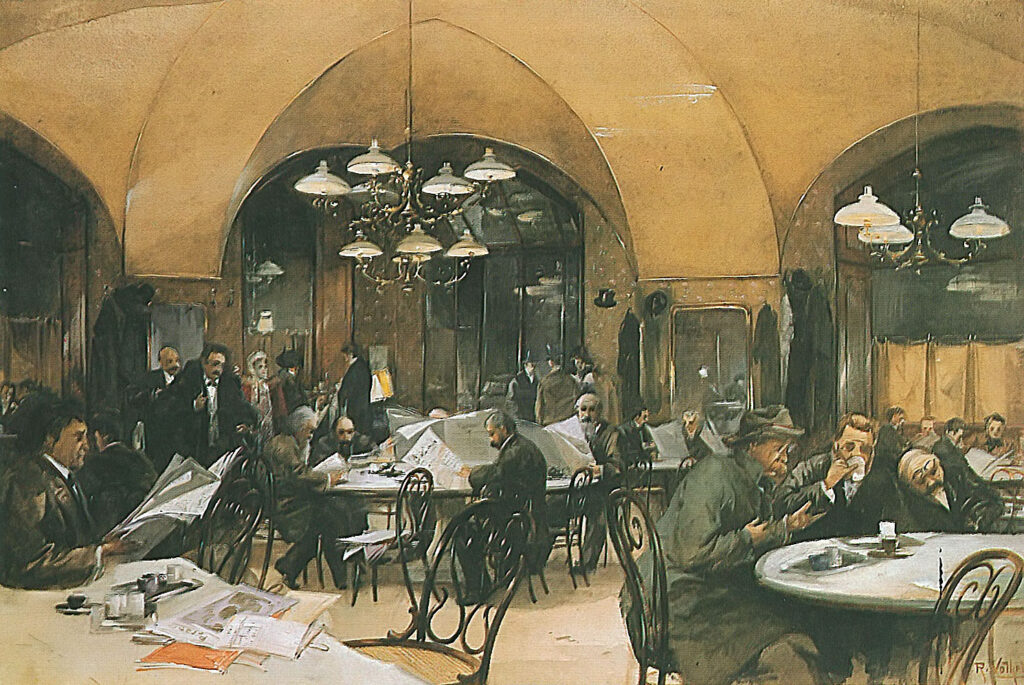
Gratuité: the charm of the absence of intent
Planning, control, predictability — what a contradiction it is to place these concepts in the context of the coffee house! The charm of the coffee house lies, precisely with regard to the question of the encounter with the new, in its absence of intent, in its unplannability, and in a stance that is not explicitly oriented toward utility. One meets others, or withdraws, in a context that is semi-public and yet not organizational, in order simply to be there, alone or in company; to enjoy being served; to “celebrate” everyday life a little; to allow oneself a short spell of Muße.
“The sphere of leisure is … the sphere of culture as such, insofar as that word denotes what lies beyond the merely useful. (p. 86) … One might say that the core of leisure is celebration. In celebration, all three conceptual elements come together as one: the absence of tension, the effortlessness, and the superiority of the ‘working of leisure’ over the merely functional. (p. 77)”
— Pieper 1965 (translated by theLivingCore / Claude Opus 5)
The coffee house’s atmosphere of relaxation and effortlessness is grounded, among other things, in its absence of intent — and that absence is one of the preconditions for bringing forth new things of real quality. It is much the same as with happiness: aim at it directly and in most cases it will be denied you. When the declared purpose of a conversation is to develop something new, the yield of such a lofty goal often turns out to be meager. The coffee house — understood as an Enabling Space — by contrast offers, in a subtle way, conditions under which the new can emerge. One of these conditions is that it is a place without intent, a place where the new can be-fall you like a gift that simply appears out of nowhere — pure Gratuité.
This Gratuité finds expression not only in the absence of intent, but also in the generosity of the space (at least in some of the old cafés); in the fact that you can sit for hours over a single Kleiner Brauner; that (good) newspapers are at hand; that you are served; that you are not showered with intrusive music; that you can unhook from everyday life. All these apparent trivialities constitute precisely the atmosphere in which the new can be cultivated.
Why the corporate coffee lounge does not work
And this is presumably also what distinguishes a coffee house from the hip coffee lounges in corporations and organizations: Gratuité and the absence of intent. When the new is pursued too overtly, and all of this is disguised as “informal conversation,” as loud or tasteful office landscapes, as free zones and “workspaces” for creativity, one should not labor under the illusion that employees fail to see through this sometimes all too clumsy game. Such apparent generosity can quite quickly be exposed as an attempt to exploit creative potential and as a covert attempt to raise productivity — thereby achieving precisely the opposite effect.
In the coffee house, by contrast, the point is not ostensibly that one has to be creatively productive. Although it says “coffee” on the outside, inside one finds other qualities, ones that cannot be simulated in the corporate or business world — or only with great difficulty: the new is a fruit, not the primary target.

Places as a technology of knowledge work
The coffee house is about social encounter and about jointly creating new spaces of knowledge. Companies that hold employee conversations or weekly jour fixes in coffee houses recognized this long ago: the significance of leaving behind organizational walls and (entrenched) boundaries in order to make important decisions with an unclouded long view, on “neutral” ground. In offsites and strategy workshops this is already widely practiced — though a great deal of potential is left lying there when such changes of place are staged as “all-inclusive feel-good oases.” In everyday routine, by contrast, a change of place is still rarely built into the workflow. Another detail that can make the decisive difference.
The coffee house itself — with its spatial realization, its social staging, its offerings of knowledge and communication — can be understood as an Enabling Space in which the encounter with the other takes place in two respects at once: I encounter the other person in their otherness, and I encounter the Other (often through the encounter with other people) in the form of the new.
This leads us back to places of learning: ultimately it is not about playing places of different qualities off against one another, be it a coffee house, an office room, or a train compartment. After all, no one would think of installing a functioning museum in the office (and we are not talking about artworks in the corridor). One goes to a museum as a specific place, in order to experience something specific there — and forward-looking companies make this possible for their employees.
But if we do not confine our working world to the office room and instead integrate places of different qualities in a meaningful and coherent way, this offers enormous potential for the much-lauded “creative class” and for knowledge workers. Places as a technology for carrying out particular knowledge-work activities as well as possible: bookkeeping in the office, conceptual work in the coffee house. Why not offer employees vouchers for a coffee house, along the lines of the ride vouchers that let them take taxis without paying cash?

Recalling itself to its own core, then, the coffee house does not need to reinvent itself: as a place that enables the new and enables learning, it is, at its core, exactly in tune with the times. Understood as an incubator of the future, it becomes interesting to ask how new information and communication technologies, new social formats, and new epistemic techniques might be used to draw out still more of the potential contained in that core.
Where is your coffee house?
At theLivingCore we call such places Enabling Spaces: environments — physical, social, cultural — that do not force the new, but invite it. The coffee house is not a template to be copied, but an object lesson. It shows that the conditions for the new can be designed, but that its occurrence cannot.
The question we put to every leadership team we work with is therefore a simple one — and usually an uncomfortable one: Where in your organization is there a place where nobody wants anything from you?
If you would like to translate the reflections in this essay into your own context — your spaces, your teams, your next transformation — we would be glad to talk with you. Write to us at welcome@thelivingcore.com, or book a 30-minute conversation directly.
References
- Clark, A. (2008). Supersizing the mind. Embodiment, action, and cognitive extension. Oxford, New York: Oxford University Press.
- Glasersfeld, E. v. (1995). Radical constructivism: a way of knowing and learning. London: Falmer Press.
- Kao, J., Nonaka, I., & Scharmer, C. O. (2000). The seventh career: building an innovation keiretsu. Conversation with John Kao (The Idea Factrory). Retrieved from http://www.dialogonleadership.org/Kao-2000.pdf (date of download: 21.09.2005)
- Peschl, M. F., & Fundneider, T. (2012). Spaces enabling game-changing and sustaining innovations: Why space matters for knowledge creation and innovation. Journal of Organisational Transformation and Social Change (OTSC), 9(1), 41–61.
- Pieper, J. (1965). Muße und Kult (7th ed.). München: Kösel.
Images / Part 1
- Featured image by Lukas Lehotsky / Unsplash
- Image 1: Aleksandr Filippov / Unsplash
- Image 2: Marcel Schachinger / Unsplash
- Image 3: Arlington Research / Unsplash
Images / Part 2
- Featured image by Johan Mouchet / Unsplash
- Image 1: Vitaly Gariev / Unsplash
- Image 2: Tingey Injury Law Firm / Unsplash
- Image 2: “Café Griensteidl” (1896) by Reinhold Völkel. Public domain via Wikimedia Commons.
- Image 3: CJ Dayrit / Unsplash
- Image 4: Markus Winkler / Unsplash
The original text appeared in: Peschl, M. F. & Fundneider, T. (2012). Die Muße küsst im Kaffeehaus. Brutstätte der Zukunft und Ort der Begegnung mit dem Neuen. In MAK & departure (Hrsg.), Das große Wiener Kaffeehaus-Experiment (S. 49 ff.). Wien: Metroverlag. The version published here has been revised, split into two articles, and given a new title; in substance it corresponds to the original. The German version was translated into English with Claude Opus 5.