
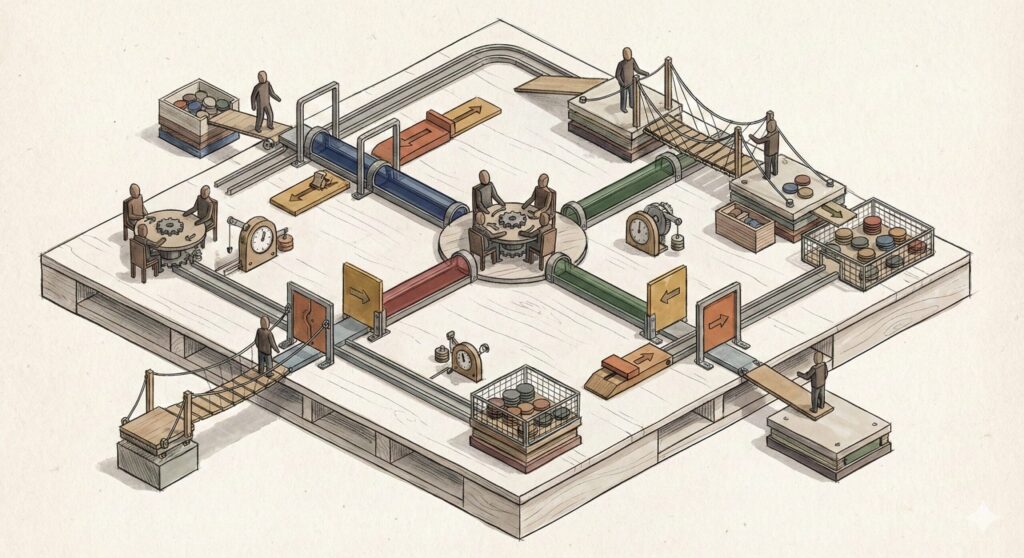
Your organization has undergone a strategy process and found a new way forward. Now the time has come to make structural changes and transform the organization hands-on: new teams, clearer roles, different ways of working together. The plan is sound. But between the org chart and the living reality of how work actually happens lies a gap—and that gap is where most reorganizations quietly fail.
Research suggests around 70% of change initiatives don't achieve their objectives. The reason isn't poor planning. Traditional planning covers what you can draw on a chart: reporting lines, roles, processes—roughly 10% of what makes an organization work. The other 90%—how people really coordinate, who knows what, the culture that shapes daily decisions—stays invisible until you're already committed. And by then, adjustments are costly.
We developed playframe to make that invisible 90% visible before full commitment: to make you experience the future challenges and merits of new structures and processes.
playframe lets you test-drive your new structure and its associated processes against challenges that haven't arrived yet. Designed as a two-day workshop with up to 100 participants, it provides a safe way to rehearse the future—discovering what works, what breaks, and what needs strengthening before the stakes are high.
Here is how it works: your teams continue their actual daily work within the new structure. In this setting, we introduce carefully designed disruptions—what we call “interventions”—that surface the dynamics org charts can't capture. A supplier delay. A key person suddenly unavailable. Conflicting priorities between teams. A client escalation that doesn't fit neatly into the new process.
These aren't abstract exercises. We co-create the interventions with our clients based on their experiences; hence they are real and relevant. Then we take up (and further shape) what emerges: how decisions actually flow, where coordination breaks down, which informal networks turn out to be critical, how people act when the pressure feels real.
The result: deep understanding of what works, what doesn't, and how the structure needs to be developed further—all this, discovered in a safe environment rather than learned the hard way. More importantly, it addresses a well-known failure mode of organizational change: when new structures are not accepted and internalised by employees, systems revert to their old structures and patterns, rendering the redesign ineffective.
Let us share an example. Grabe Ingenieure is an engineering and planning firm for technical building systems—heating, cooling, plumbing, electrical networks, building automation, with around 40 employees.
The situation: The managing directors wanted to focus on their core responsibilities, but they were so caught up in project work that they had little time to develop the company further. Leadership reported that the current structure couldn't support growth—the way teams were organized did not allow them to easily take on new projects or clients. Client acquisition had to happen on the side, squeezed in around other demands. Meanwhile, informal habits kept pulling the directors back into daily operations. For instance, decisions that teams could have made on their own were instead being passed up the chain out of habit, demanding the directors' attention.
Grabe therefore developed and adopted a new leadership and team structure. Team leads would take on real authority by staffing projects, managing client relationships, and owning budgets. Teams would operate more autonomously, handling as much as they could handle rather than escalating by default.
The design addressed a real need. But would the organization's deeper patterns (its culture, its habits, its informal networks) actually support it?
That's where playframe came in. We worked with the leadership to co-create interventions tailored to Grabe's reality. These “intervention cards” were designed so that they capture different topics and challenges in a meaningful and balanced way, covering topics such as resource allocation, HR, planning, etc. On the first workshop day, while employees went about their regular project work in the new structure, we introduced these interventions at the points where they would naturally arise in real life. A project timeline compressed unexpectedly. A resource conflict between two teams. A client request that didn't fit the usual categories.
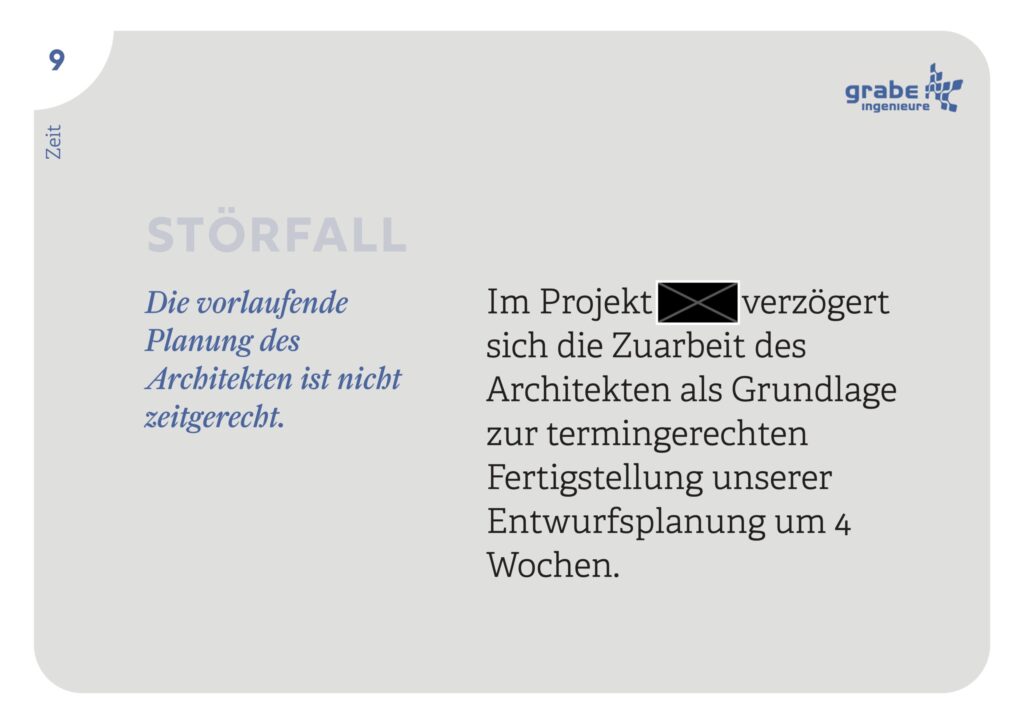
We, together with our client, carefully documented how the organization responded to the intervention. How did the team deal with its new decision powers? Where did old habits reassert themselves—decisions routing through familiar channels, people hesitating at boundaries that no longer existed? Where did the structure hold, and where did it need strengthening?
By the end of day one, we had a picture not of the structure on paper, but of the structure in action.
On day two, we worked through the findings together. Some things surprised. The directors hadn't expected how quickly their teams took ownership—or how rarely anyone knocked on their door to escalate decisions. At the same time, gaps emerged that no one had anticipated: how should ongoing projects be handed over when team structures change? Who owns what at the boundaries between teams? How do the new teams access resource planning and monitoring? What rules apply when teams decide on holiday requests internally?
These weren't failures—they were exactly what playframe is designed to surface. By the end, Grabe's people understood the new structure differently: not as something imposed, but as something they had tested, questioned, and helped refine.

Every organization considering structural change faces the same uncertainty: Will this actually work when it meets reality?
As you can see, playframe surfaces what planning cannot:
Pulling your employees away from their daily tasks and project work can be costly. The playframe format, however, is firmly rooted in real work. Rather than pulling everyone into a conference room for hypotheticals, playframe creates a kind of time compression in which your employees encounter dynamics that would otherwise take months to surface, but which become visible in hours. All the while, they engage in real tasks and stick with real deliverables.
As your people are part of this process, they do not just understand the new structure intellectually. Rather, they will sense how it works, help shape what it becomes, and thus make it a “lived” structure.
playframe will be most useful for you when you adopt a novel strategy and design a new structure but sense a gap between the plan and how your organization really works. Perhaps you are aware of hidden dynamics (informal networks, cultural patterns, coordination habits) that could quietly undermine the change—leading to stalled decisions, faltering coordination, and teams drifting back into old patterns despite the new design. By the time these problems surface on their own, you have already lost months, trust, and momentum.
playframe is a small upfront investment to prevent all this—and instead, it is giving your employees the chance to experience and co-shape the change, not just receive it.
If you're introducing structural change and want to know whether it will actually hold, we would welcome a conversation.
Register and receive special insights into the latest developments.