

In the heart of Vienna, a transformative journey is unfolding at the ÖBB Open Innovation Factory. Opened in March 2023, this pioneering space at the new ÖBB headquarters is not just a physical location.
It’s the epicenter of a vision – “Mobility as a Commons”. As one visitor astutely observed, “ÖBB has taken a courageous step with this space!” And she would know, being responsible for innovation at one of Europe’s most innovative real estate developers.
What‘s the story behind this space and what was theLivingCore‘s role in it? Read on and find out.
Background and the Mobility Manifesto
In 2019 – 2020, ÖBB’s Open Innovation Team worked with various external stakeholders to develop the Mobility Manifesto, which should serve as a founding document for a broad mobility community: established companies, start-ups, organizations from the public sector, and academia.
The goals:
- to provide impulses for new mobility concepts
- to further develop mobility in Austria with a focus on climate protection and social responsibility.
ÖBB had been pursuing a strategy of office consolidation for several years and finally found a suitable property in Lassallestrasse: The new headquarters covers about 46 000 square meters and offers space for 1 700 ÖBB employees.
So how did we approach this project to give the Mobility as a Commons community a home and a space for innovation?
Step 1: Defining the Purpose – Navigating Organizational Shifts
When the head of ÖBB’s Open Innovation Team, Peter, invited us to set up and steer the entire space design process, we first had to create clarity about the purpose and users of the space.
This was the first important milestone in the project and it was not an easy decision to make, as it raised mainly organizational and cultural questions, such as:
- How can a mindset shift towards collaboration, agility and prototyping be achieved (within an established and state-owned organization)?
- How open can we make a space that is located in an ÖBB-branded building?
- How will people who are not ÖBB employees have access to it?
- Can the space look different from the surrounding offices?
- What should the rules of cooperation be? What is the “code of conduct” to be followed by everyone working there?
- Should meeting rooms be bookable – if so, for what purpose?
- Will people be able to drop in and work on their own?
- And if so, are visitors allowed to take free coffee?
- How do we address the issue of access and security?
Designing a new space is a unique way to initiate organizational change. Changes in the organization are supported by and manifest in the space. Successful and sustainable space design requires clarity about where the organization wants to go, what it wants to achieve, and what the focus of the work should be.
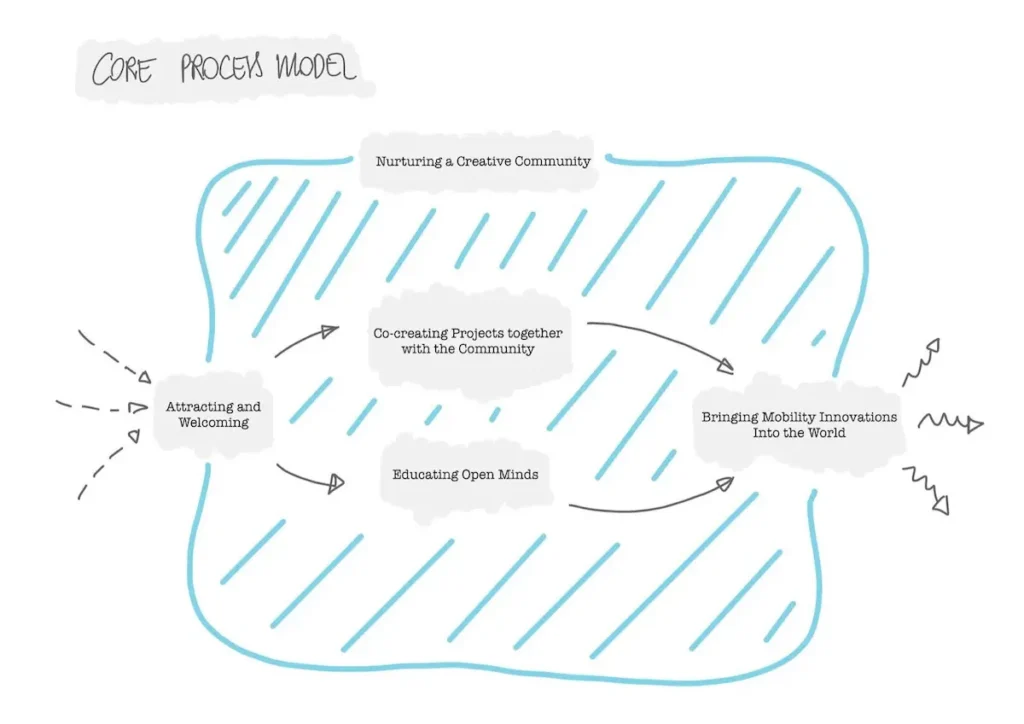
Step 2: Core Process Model
Our strength is to take a highly complex ambition and future purpose and distill it into what we call a condensed core process model. This core process model:
- describes an organization and its goals at a highly aggregated level, capturing the essence of the ambition without losing sight of its complexity.
- represents the essence of an organization’s intentions, activities, relationships, and its future potentials.
- is the master plan on which all subsequent realization steps are based (like architecture, interior design, operating model, communication, strategy, organizational design, and so on).
Based on our research, generative interviews and co-creation workshops with stakeholders, we suggested 5 core processes for the ÖBB Open Innovation Factory.
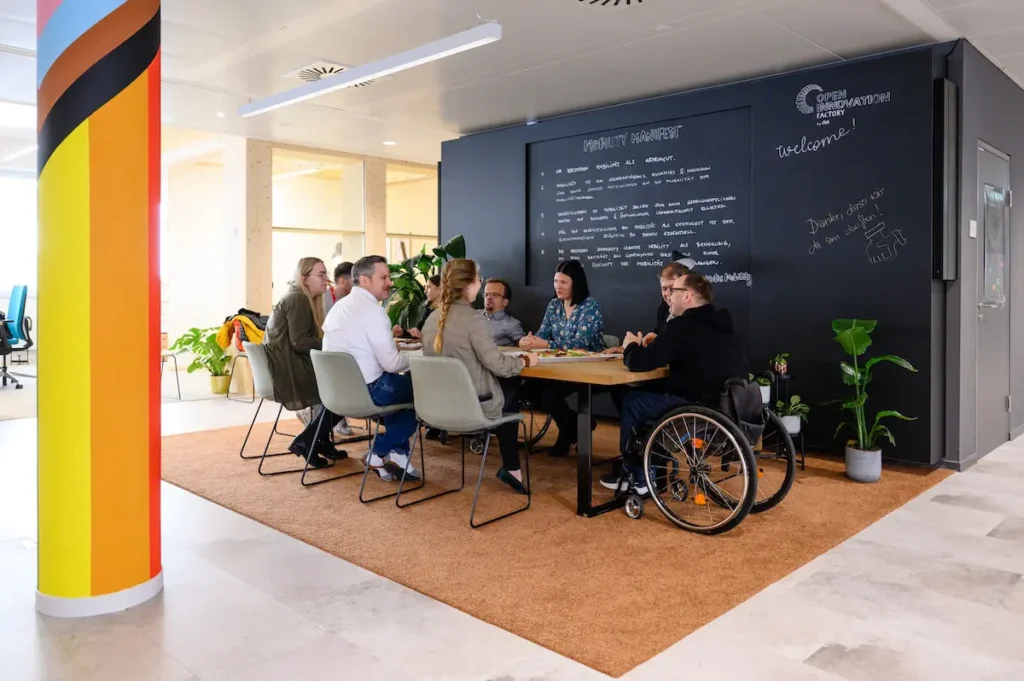
Core Process 1: Attracting and Welcoming
This core process is about welcoming people and bringing them into the community. The goal is to spark curiosity and a desire to innovate, learn, and share about mobility.
Experiencing this core process as a visitor is so important because:
- New things and innovation always involve a certain amount of uncertainty, which makes it all the more important to welcome people authentically and give them a sense of security, in the sense of “We’re glad you’re brave enough to be here.”
- Innovation is often intangible. This is an opportunity to experience innovation in a low-threshold way – “innovation you can touch”, which makes you want to be innovative yourself.
- For experienced innovators, this core process is important because it creates a sense of “intellectual/cultural homecoming” – they realize: this is different, this is special, here I can think about things I could not in my organization, and I can meet people I would not meet elsewhere.
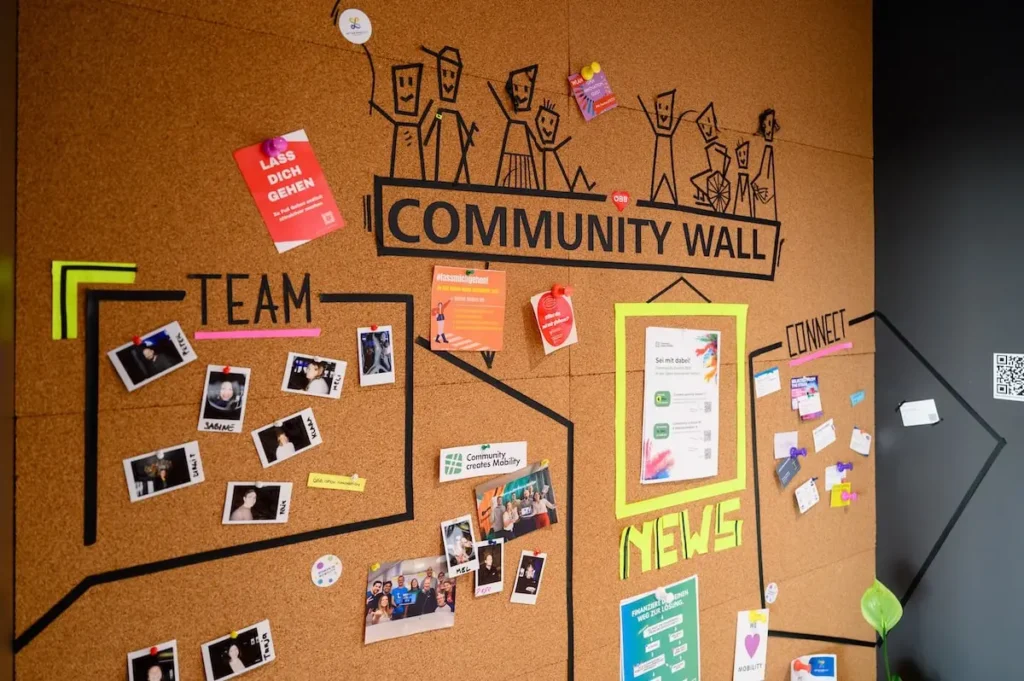
Core Process 2: Nurturing a Creative Community
This core process is about actively developing a community around innovation and mobility – primarily through a shared purpose from which mobility innovation projects emerge. But it also requires special social rituals and artifacts (learning journeys, mobility manifesto, special event formats, and so on).
For this core process to work, people from the ÖBB Open Innovation Team would have to take over the scouting of the best innovation team members and support them consistently.
Because heterogeneous teams (education, organizations, interests) need time and space to “negotiate” a common project mindset and an innovation approach that is supported by all participants.
The Open Innovation Factory makes this possible. Through the community, all participants have access to multidisciplinary know-how and it promotes togetherness.
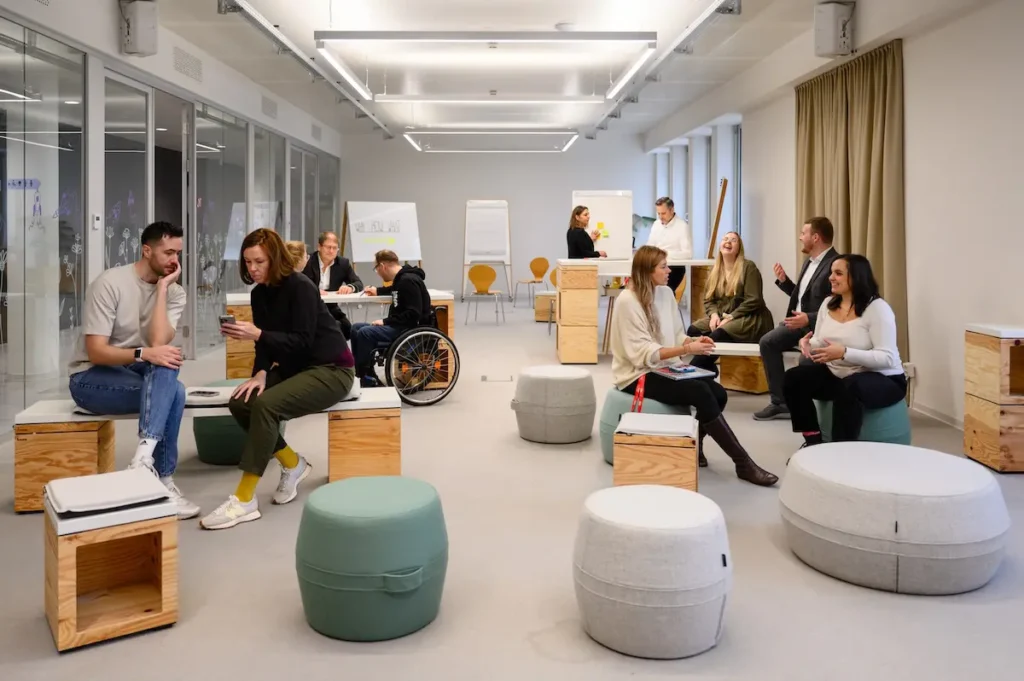
Core process 3: Educating Open Minds
This is about educating people about innovation in a holistic way. This cannot be done through traditional innovation training (following a predefined course catalog). It has to be project-based, triggered by an innovation context, and ad hoc.
- The topics dealt with are cutting-edge and not yet offered within ÖBB (e.g. training and exchange on organizational theory, entrepreneurship and (innovation) coaching).
- The “course formats” are stimulating and have a “laboratory character”, there is a lot of experimentation and the focus is on learning together and from each other.
- The goal is not only to learn new skills and methods, but to enable personal transformation at the level of attitudes and mindsets.
This core process should also attract people who are not working on projects. It gives the space a vibrant and living spirit. What is learned is immediately applied to projects and/or taken out into the world and one’s own organization.
Core Process 4: Co-Creating Projects Together With the Community
How can we find answers to complex global problems and innovate for a future that is uncertain, unpredictable, and ever-changing?
… Innovation is not so much dependent on the creative activity of an agent / innovator. Rather, we suggest to turn things on their head: if we want to shape an unfolding reality in an open-ended and purposeful manner, we have to acknowledge that we have to give up epistemic control and have to engage in an emergent process of co-becoming and co-creation with future potentials.
Peschl (2020)
The community focuses on identifying forward-looking topics related to mobility and developing projects that shape the future. The results of such projects should create social value and be effective beyond the benefit for the individual.
Traditional innovation approaches are not the right tools for this, as they are strongly solution-oriented from the outset or often focus on existing users.
This core process therefore focuses on finding space to disrupt the existing and aims to create an “ecosystem” in which multiple key players and solutions (products, services, business models, etc.) can be brought forward.
This core process is quite “tricky” and the ÖBB Open Innovation Team is currently working on defining the right innovation approach. Our recommendation was to establish a specific “Community Innovation Process” that starts before the classical “Exploration Phase”:
This preliminary phase is about “learning from the future”, identifying potentials, formulating the right research questions and setting highly relevant topics (>10 years).
Core process 5: Bringing Mobility Innovations Into the World
Innovation projects need a “safe space” at the beginning so that emerging new knowledge (intuitions, potentials) can be sharpened, developed, and tested. However, there comes a point when it is time to bring the innovation into the world.
This is a critical phase in which the novelty often threatens to fail due to the dominance of the existing (for example, it is not understood, it is scary, it seems too difficult to implement, and so on). This phase requires very specific and targeted support and the involvement of the relevant stakeholders.
This core process is important because it is a strong bonding agent for the mobility community (communities often disintegrate because nothing tangible comes out or no impact is created).
If the goal of the community is to create social benefits, the focus must be on bringing the results of the projects to society (the public, companies, universities, and so on). However, results are not only products or services, but also changed behaviors, attitudes, or value systems.
Space Design And Zoning for Impact
Sabine Prettenhofer is the curator of the ÖBB Innovation Space. She joined the Open Innovation Team at the end of 2022 and therefore did not experience the genesis of the space in detail.
When I discussed the core process model with her and how it relates to the space, her first reaction was: “Now I am really relieved that there is such a well-founded background for what I already do partly intuitively. This opens up a whole new perspective on how we can develop the Factory”.
And then Sabine talks about a student from the Vienna University of Technology who comes to the Factory every week. She always brings other students with her and they work on projects about public space planning.
And Sabine talks about the “Platz für Wien” association, which meets here once a week. “They would otherwise have to go to the coffee house because they don’t have the budget for an office, and here they have perfect working conditions.”
Sabine is thrilled that ÖBB provides space for such people and initiatives: “It’s important that there are places like this for people and institutions that are driving projects important for all of us.”

zoning
Based on the as-built plans and the planned core activities, we set about zoning the space:
- Where should each core process take place? Why?
- Do some of them need to be adjacent to each other?
- What atmosphere and qualities should each zone have? Loud-quiet, open-closed, exciting-calming?
- Where should individual zones merge into one another?
- How should the transitions be designed – clear demarcation or flowing?
- How can the design provide orientation and clarity about the purpose of the space?
This approach gives us a sense of the whole space and helps us to check how cognitive and social processes are integrated. We go into great detail at this stage, but not by suggesting furniture arrangements, as is often the case.
We think in detail about possible human interactions and plan “collisions of knowledge”. We design the space as a cognitive and emotional map of the future users.
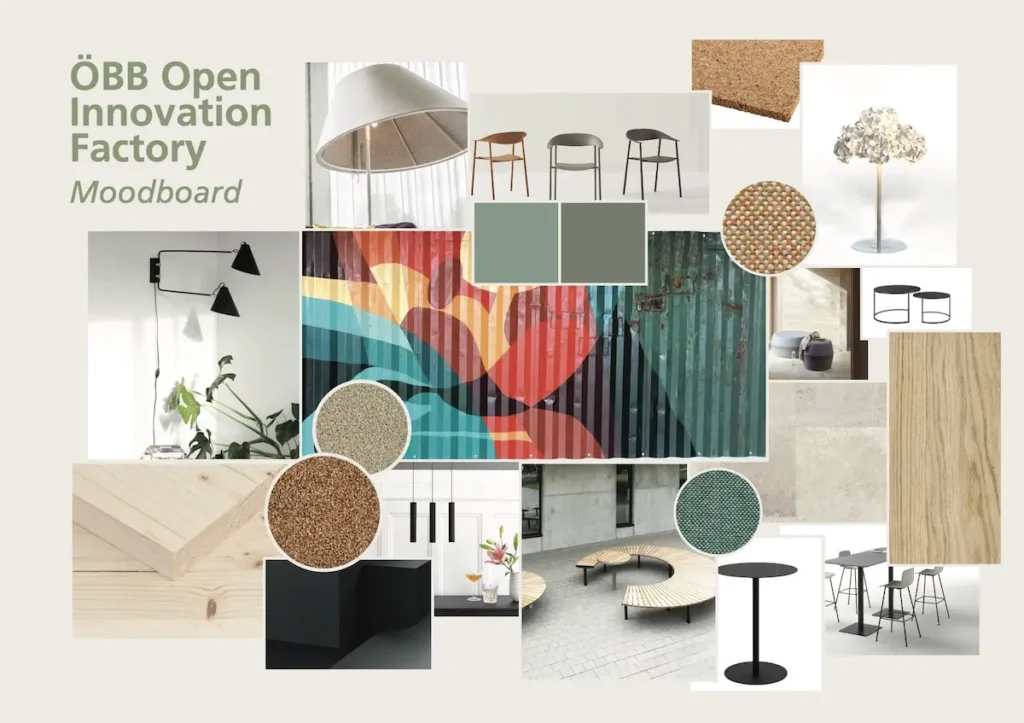
To this end, we also create mood boards that include the most important activities of each zone and the most frequently encountered users, as well as design elements, color schemes, and generally the desired atmosphere.
After all, just like in a city, we don’t just move around an office space based on factual markers (street names, house numbers, and so on). Our paths are decisively controlled emotionally and physically, unconsciously responding to questions such as “how does it smell in a certain environment?”, “is it light or dark there?”, or “do I feel alive?”
Prototyping, Challenges, and Evolving User Needs
We then moved on to user requirements, furniture layouts, and building specifications. This phase of the project (as is almost always the case with spatial projects) was characterized by a “back and forth” between the client, the future users, the architect, the subcontractors and so on. In our experience, this often leads to conflicts of interest.
In our experience, projects often come to a standstill here, or decisions are revised and details are negotiated in seemingly endless discussions. This happens because the question “What should happen here and how?” has often not been answered in advance.
The core process model and mood boards provided guidance and served as a corrective in the decision-making process.
We consider the prototyping of furniture settings and work practices to be an important part of designing a functional space. For the ÖBB Innovation Factory, the project space area was a place we wanted to prototype in detail.
Based on the core process of “Co-Creating Projects Together With the Community”, we proposed a spatial setting that would allow the creation of several project islands to provide a workplace for different project teams from ÖBB and the community for several weeks, months, or even years.
The idea was not to have separate, fixed rooms, but rather that a project team could create a small island for itself that could grow with the project.
On the one hand, this island should serve as a home base for the project members, but it should also have a communication function to the outside world. This means other project teams should be able to find out about the project, for example, through posters.
The guiding idea was to provide the project team with what they need at that moment.
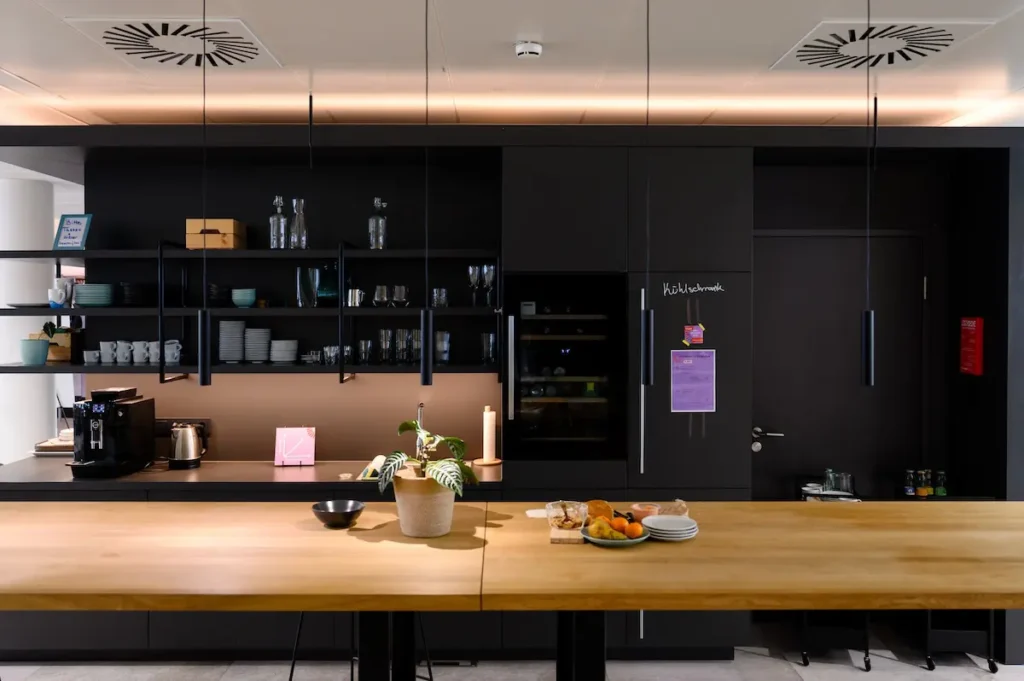
Although our client found the idea of project islands very interesting, they ultimately decided to leave this area of the Open Innovation Factory unfinished.
Why? Because it was not clear to them how many project teams would actually be interested in this space and what support services the Open Innovation team could provide.
We thought it was a bold decision – and it turned out to be the right one. Now the demand for this space is high, and project teams are designing their own project islands from existing furniture provided by the Open Innovation team.
This is a wonderful opportunity to observe what the teams really need and then get the furniture set up accordingly.
During these months, our architect Didi and our interior designer Isi have been on site at least once a week to coordinate or lend a hand. From our point of view this effort is absolutely necessary for the success of such a big project, because details matter and often make the difference if and how a space is accepted by the users.
And it has happened that lights already installed have been dismantled and replaced by more pleasant ones.
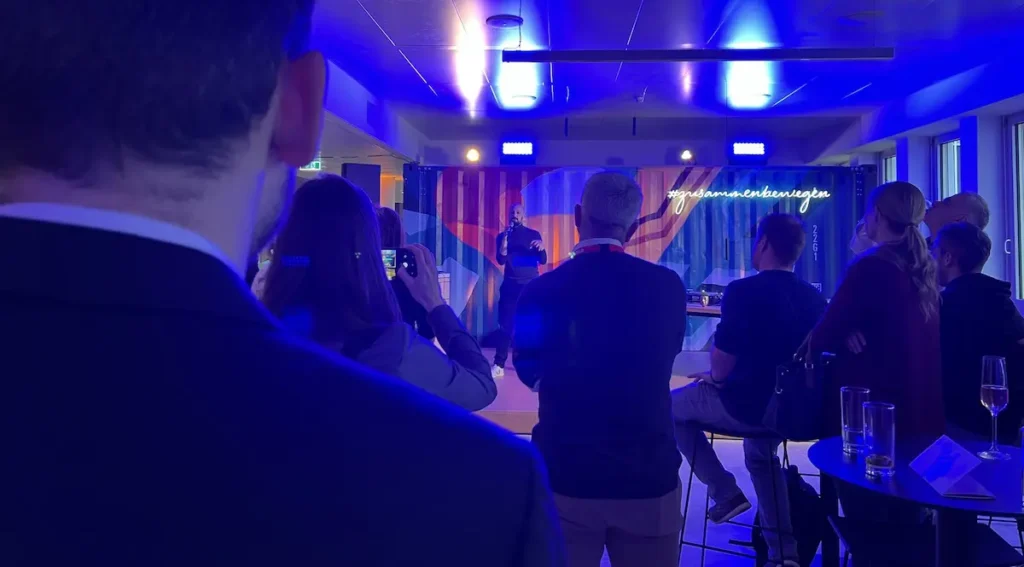
Opening Day: Unveiling ÖBB’s Innovative Achievement
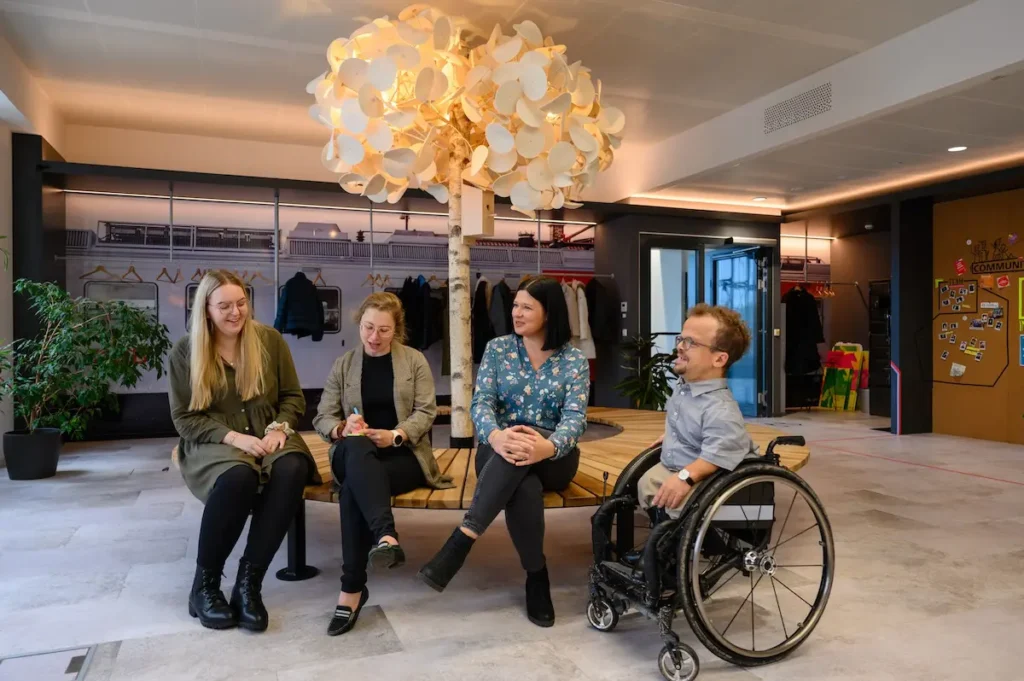
As the ÖBB Open Innovation Factory comes to life on its official opening day, an electric energy fills the air. The diverse crowd explores the intricacies of the Welcome Space and marvels at the towering presence of the giant tree. We hear whispers of admiration among the impressed faces: “This room is unique”, “ÖBB has dared to do something”, “I would like to work here”.
These words are more than a reaction. They are the crescendo of months of collective effort and the realization of a bold vision. Our heartfelt gratitude goes to Peter Schindlecker and his dedicated team, and to all those who have been instrumental in bringing this project to life. It’s not just a room. It’s a testament to innovation, a hub for transformative ideas, and a canvas for future possibilities. Thank you for your trust and commitment to reimagining the future of mobility with us.
Explore Strategic Innovation with theLivingCore
As we reflect on the successful collaboration in crafting the innovative ÖBB Open Innovation Factory, we extend an invitation to those seeking to elevate their own innovation spaces. If you are contemplating transformative changes in your organization or wish to explore new possibilities in innovation, we invite you to schedule an introductory call with our founder, Thomas.
Discover how our consulting services have empowered ÖBB, and let’s engage in a conversation about how we can bring a similar transformative impact to your organization.
Ready to revolutionize your approach to innovation? Schedule your introductory call with Thomas now and embark on a journey of strategic innovation.