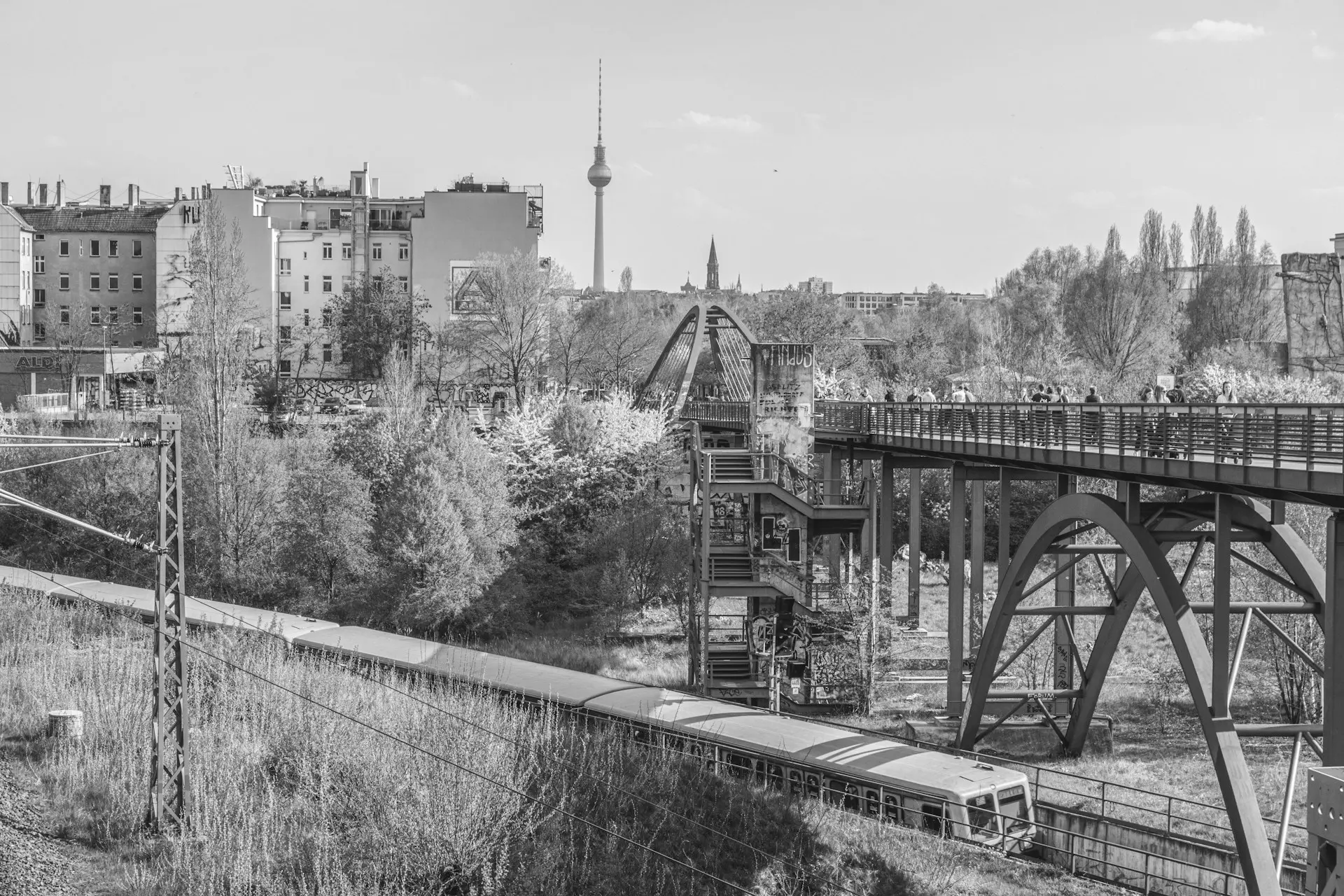
In urban planning, we tend to focus on the built: offices, houses, retail, infrastructure, sort of what is addressable on Google Maps. Everything else is either invisible or treated as a development opportunity by real estate companies. I believe this is a profound planning error. A special kind of space, the so-called in-between space, eludes structured planning altogether. Walk through any city and you will find them: the gap between a fire station and a parking garage, the weedy strip along a canal, the vacant lot where teenagers gather after school. Most planning maps leave these spaces blank. Yet it is precisely in these blank spots that some of the most important urban life takes place.
The “in-between” bears potential for hosting the new and creating opportunities that do not exist in formally defined places. More importantly, “in-between” does not only refer to a physical site. It speaks to our intentions, our awareness, and our understanding of what a city could be. When we plan only for function (housing here, commerce there, recreation over there) we squeeze out the unscripted encounters that make urban life worth living.
What Are In-Between Spaces?
In-between spaces are the voids, gaps, and edges between built forms, the leftover spaces that tend to collide unintentionally or create divisions nobody planned for. Take, for example, the brownfield behind a railway line, the narrow passage between two apartment blocks, the wasteland where a petrol station used to be, or the unplanned playground that children claim at the foot of a social housing tower.
These spaces are fundamentally different from what the anthropologist Marc Augé called “non-places” such as airports, shopping malls, motorway service areas. These places are defined negatively, by what they lack, and not by what they are: They are devoid of identity, history, and relations. In-between spaces, by contrast, create a sense of identity, foster social interaction, and enable exploration. They are a pause in functionality: not yet defined, they carry different potential futures shaped by those who engage with them.
Examples are everywhere once you learn to see them: brownfield sites (not contaminated), waste ground reclaimed by neighbours, intermediate spaces between buildings and the street, stalls, urban gardens, impromptu football pitches; in short, spaces that become a place through use rather than definition.
In summary, in-between spaces are non-commercial, uncontrolled, accessible to all, not yet determined, and they invite their users to shape what comes next.
Why They Matter More Than Ever
Several converging developments in recent years have made in-between spaces not just desirable but essential. From the lessons of a global pandemic to the quiet political consequences of losing the places where communities gather.
The Pandemic Proved the Point
COVID-19 turned the spaces between buildings into critical infrastructure almost overnight. While interiors became dangerous, sidewalks, vacant lots, and leftover corners became places to eat, exercise, socialize, and breathe. Research published in the Journal of Engineering and Applied Science (2023) documented how tactical urbanism (based on rapid, low-cost, scalable interventions) transformed neglected urban voids into temporary public spaces during the pandemic. Pop-up markets in parking lots, open-air classrooms on dead-end streets, yoga sessions on abandoned railway platforms: what had been invisible suddenly became indispensable.
There is a clear lesson to be learned: Cities that had preserved their in-between spaces were more resilient. Those that had filled every gap with commercial development found themselves scrambling. The pandemic did not create the need for in-between spaces, it revealed a need that had been there all along.
The Disappearance of Gathering Spaces
A striking study from the French research institute CEPREMAP, widely reported in early 2026, traced the political consequences of losing informal meeting places. France lost 18,000 bar-tabacs between 2002 and 2022, those modest cafes where locals would gather over coffee, discuss the news, and simply be among neighbors. In 22% of cases, the municipality that lost its last bar-tabac was left with no remaining communal facility at all: no restaurant, no library, no sports hall, nothing. The researchers found a significant and delayed effect on voting for the far-right Rassemblement National: +0.92 points after 15 years, +1.28 after 20 years. In rural areas, the effect on presidential elections reached +3.3 points.
The mechanism is not mysterious. When the last informal gathering space vanishes, people feel abandoned. As the sociologist Ray Oldenburg argued decades ago, “third places” (neither home nor work) are where community is woven. A 2019 study in the International Journal of Environmental Research and Public Health confirmed that these spaces are associated with wellbeing, sense of belonging, and reduced loneliness. By 2024, 17% of Americans reported having zero close friends, up from 2.5% in 1990. The erosion of informal gathering spaces is both a symptom and a cause of that isolation.
Paris as a Living Laboratory
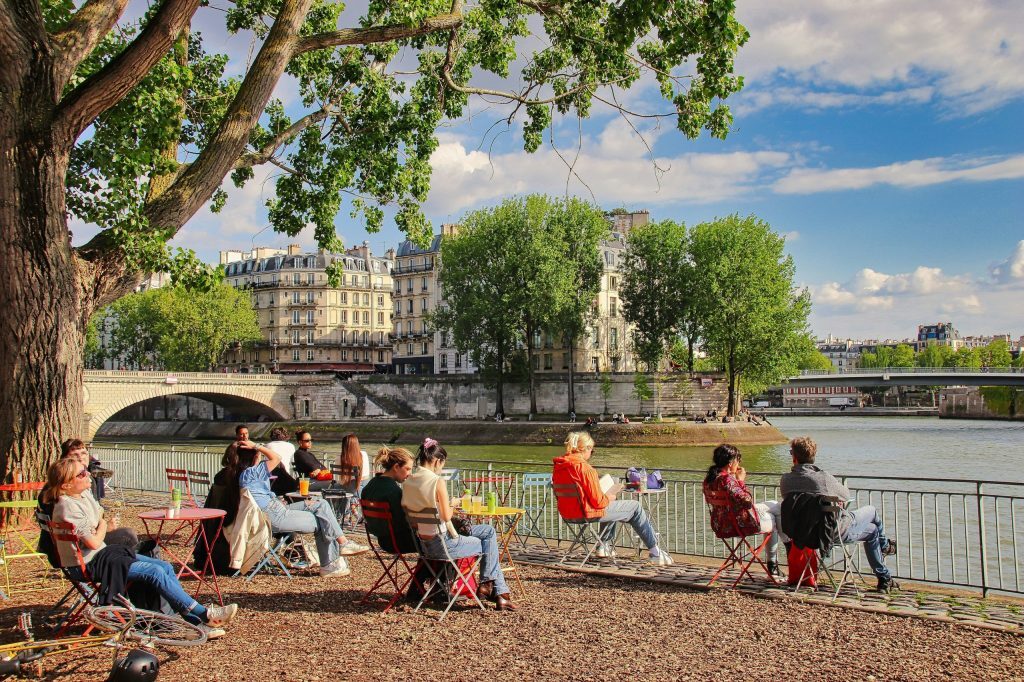
Paris offers some of the most vivid contemporary examples of in-between spaces being reclaimed. In the 12th arrondissement, a stretch of the abandoned Petite Ceinture railway has become Bercy Beaucoup: 9,000 square meters of shared gardens, a guinguette (open-air bar), workshops, concerts, and karaoke nights – run by four associations, not by a developer. There is not a matching cup or a straight lampshade in sight; the aesthetic is one of creative imperfection, and that is precisely the point.
In the 20th arrondissement, the neighborhood of Ménilmontant, once a working-class quartier with deep North African roots, was named one of the world’s coolest neighborhoods by Time Out in 2025, much to locals’ bemusement. What makes it special is not a museum or a monument but the texture of daily life: community-run art spaces, inexpensive couscous joints, bar terraces that spill onto pavements. It is, in Guardian writer Alexander Hurst’s phrase, a place where you can “simply hang out.” In March 2026, a 3,000 m² closed off venue called PRINT opened in a former Orange telecom building that had been vacant for years, turning a corporate void into a space for music, food, and gathering.
The City of Paris now actively cultivates what it calls tiers-lieux (third places) across the city. La Grande Coco in the 20th, Les Cinq Toits in the 16th, La Maison Faitout along the Petite Ceinture: these are spaces where people come to garden, eat, repair bicycles, rehearse theatre, and simply meet their neighbors. They are the institutional recognition that in-between spaces are not a planning accident but a civic necessity.
What Other Disciplines Tell Us
The case for in-between spaces is strengthened by perspectives from well beyond urban planning.
Ecology: The Power of the Edge
In ecology, an ecotone is the transition zone between two ecosystems: forest meets meadow, river meets bank. These edges are among the most biodiverse and productive zones in nature. Recent research in urban ecology shows the same principle at work in cities: edge density of green cover positively influences pollinator richness, and cities are emerging as unexpected refugia for biodiversity. A 2025 workshop series under the European Research Council’s NovelEco project explored how “urban wilding” (i.e. designing for the cohabitation of human and non-human species) can turn neglected edges into ecological assets. The powerful lesson for planning is that the most alive zones are not at the centre of things, but at the boundaries.
Neuroscience: Edges Restore the Mind
Neurourbanism, a growing field that uses wearable neuroimaging to study the brain in real-world environments, is producing striking findings. Exposure to green and semi-natural spaces, precisely the kind of unfinished, in-between environments discussed here, is associated with increased grey matter volume, improved attention, and reduced amygdala activation (a marker of stress). A 2024 study in Biological Psychiatry found that greenspace exposure during adolescence correlated with greater cortical surface area growth in brain regions linked to cognition. Meanwhile, current city living was found to increase amygdala activity during stressful tasks compared to rural living, but proximity to green or transitional spaces within the city buffered that effect. In-between spaces, it turns out, are not just socially restorative; they are neurologically so.
Complexity Science: Where Emergence Happens
Cities are complex adaptive systems, and complexity science tells us that the most interesting behavior occurs at the “edge of chaos”, the zone between rigid order and total disorder. A 2024 systematic literature review of 91 studies linking complexity theory to urban sustainability confirmed that self-organization and adaptive governance are most effective when planners set broad conditions rather than prescribing specific outcomes. In-between spaces are, in this reading, the urban equivalent of the edge of chaos: unscripted zones where new patterns of use, community, and meaning can emerge without top-down direction.
Designing for the In-Between Spaces
In-between spaces are “empty spaces” that can be filled with any possibility. What their users project into them, an urban jungle, a sheltered hut, a stage, shapes the space as well as anyone who engages with it.
“Cities try to raise their profile by constructing new shopping streets and pavement cafés, hosting festivals, and allowing food trucks to operate in public squares. This increased commodification of spaces often leads to social inequality and the exclusion of certain groups. Free access to public spaces is increasingly threatened by privatisation and commercialisation.”
— Irina van Aalst
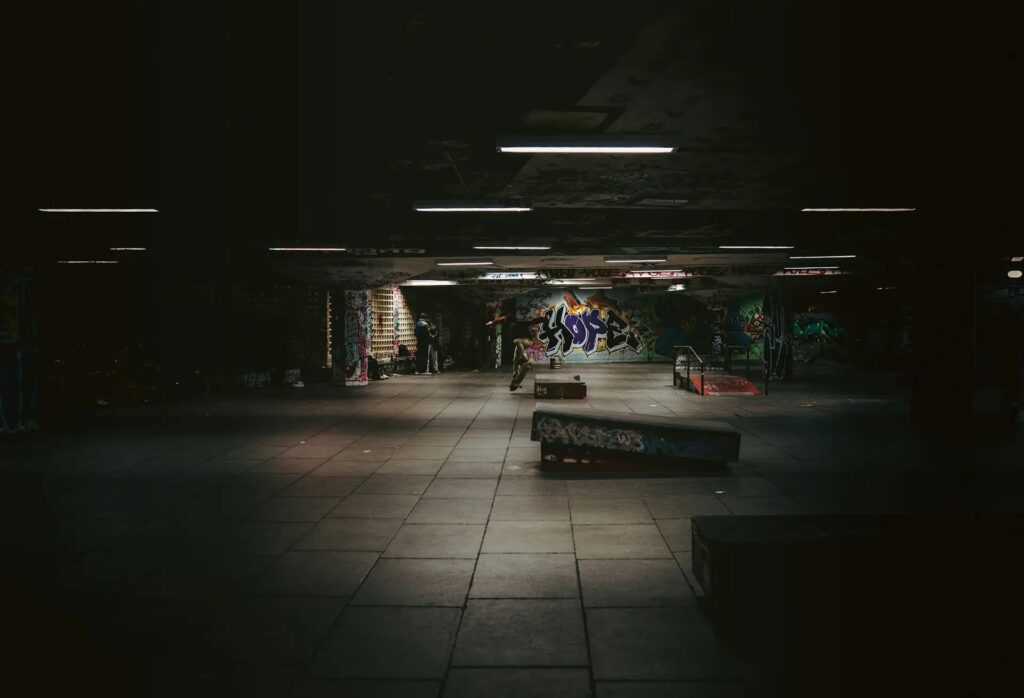
In-between spaces celebrate diversity and difference by signaling that everyone is welcome, free and safe to enter. They blur the boundaries of public and private, formal and informal. Especially young people suffer when they disappear. Forced into predetermined settings, like shopping center, the school, the parents’ house, teenagers lack opportunities for private, independent behavior. Exploring unconventional ideas, testing identities, learning to be in the world on their own terms. “Hanging out” in an in-between space is the quiet work of becoming, rather than idleness.
What now?
So, what can we do? Three things, at minimum.
First, we need a mindset shift. From seeing in-between spaces as disturbances to recognizing them as crucial elements of both rural and urban environments.
Second, we should resist the urge to over-design. Not every space needs to be “final and polished.” The best spaces are unfinished. Not predetermined by convention, they emerge and change through the interactions of their users. This also applies to your own home and (to a lesser degree) to offices.
Third, city officials and developers need to actively provide opportunities for in-between spaces to exist and persist. Paris’s tiers-lieux program shows this is not utopian, it is policy. The 15-minute city model, now being adopted from Paris to Cleveland to Singapore, implicitly depends on a fine-grained urban fabric that includes unscripted spaces within walking distance of every resident.
Living cities thrive through diversity and openness. The void is not the enemy of the city – it is its creative engine. Every time we fill a gap with another glass-fronted retail unit, we eliminate a space where something unpredictable could have happened. Every time we leave a gap open, or better, protect it, we give the city room to breathe, to experiment, and to become something we had not yet imagined.
From Cities to Organizations: Where Is Your In-Between?
The same principle that animates living cities also animates living organizations. At theLivingCore, we call these unscripted zones Enabling Spaces: the rooms, conversations, and cultural gaps where strategy can breathe, where new meaning can emerge, and where innovation is not engineered but invited. The voids and edges that matter in cities matter just as much in teams, leadership cultures, and whole organizations.
So the question we would put to you is the same one we put to every city planner, every executive team, and every leader we work with: Where in your organization are you leaving room for the new?
If you are curious how the thinking in this essay translates to your context – your strategy, your teams, your next transformation – we would be glad to start a conversation. Reach out at welcome@thelivingcore.com, or explore more of our work in Viewpoints at thelivingcore.com.
Images in order of appearance: Fionn Grosse, Alain Rouiller, and Rohit @ Unsplash